
Sky’s The Limit: William Kraft’s Lost Masterpiece (now found)
Garret Harkawik / 3.6.26
Originally published in the Cracker Barrel, a bi-annual, print-only newspaper available in southern Vermont.
The music I wrote was not something that had to be listened to; in fact, there is no beginning or end. It’s just environmental music.”
-William Kraft
Recently I was at Twice Blessed (my local thrift store), perusing the music section when I came across something that got me so excited I laughed out loud with joy. It was CD called “Sky’s The Limit,” and it was composed by William Kraft. I had never heard of William Kraft or the composition, but the CD bore the hallmarks of something that I would absolutely love.
I spend a lot of time rummaging through the used CDs at local thrift stores because I’m perpetually on the hunt for something specific: self-released music from the 80’s an 90’s, generally new age or singer-songwriter type stuff. These CDs bear a number of hallmarks that I have come to easily identify: the cover art is usually a single image, like a nature scene or the musician on vacation, not unlike releases from Windham Hill, the prolific new age record label from the 80’s whose LPs can be found in almost any used record bin. Windham Hill’s founder William Ackerman currently resides in southern Vermont, where he moved after selling the label to BMG (perhaps he chose Windham Country because he likes the name Windham?)
Other indicators I look for include: No record label listed. The font is usually comic sans or some other ghastly choice. The contents are copyrighted to the performer, if there is any copyright at all. And, most importantly, the songs are all originals and not covers.
I love these albums for two reasons: they’re unfiltered and they always contain at least one incredible song and they’re typically otherwise completely unavailable elsewhere.
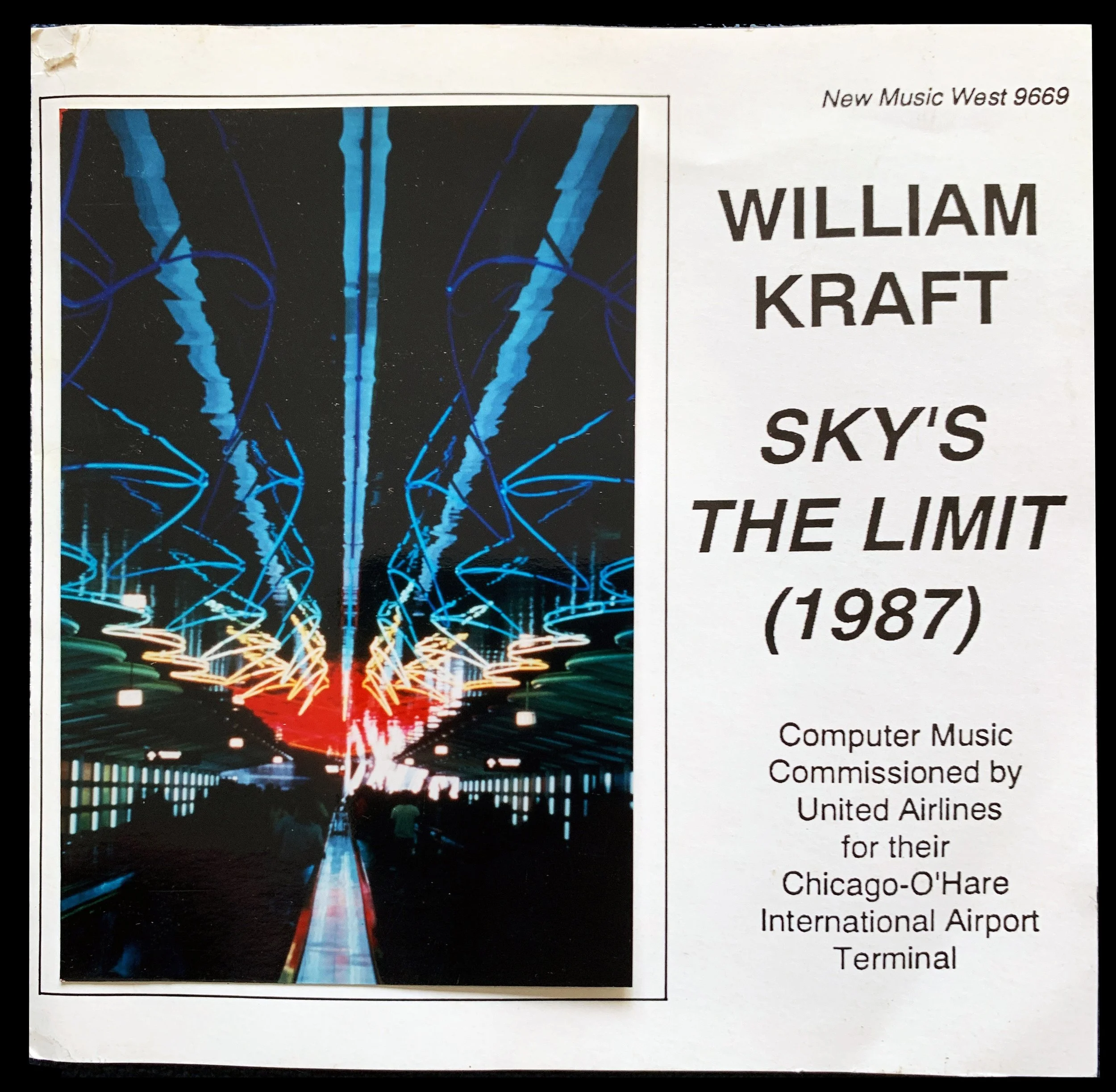
I was immediately drawn to “Sky’s the Limit” because of its minimalist packaging. The cover is reminiscent of a Windham Hill release, with an abstract image of light and bold text on a white background (I later discovered that the image on the cover is actually a photo glued onto the CD booklet). While it did have a record label listed (New Music West), it wasn’t one I was familiar with. What really got me excited though, was the description of the music on the front of the CD case:
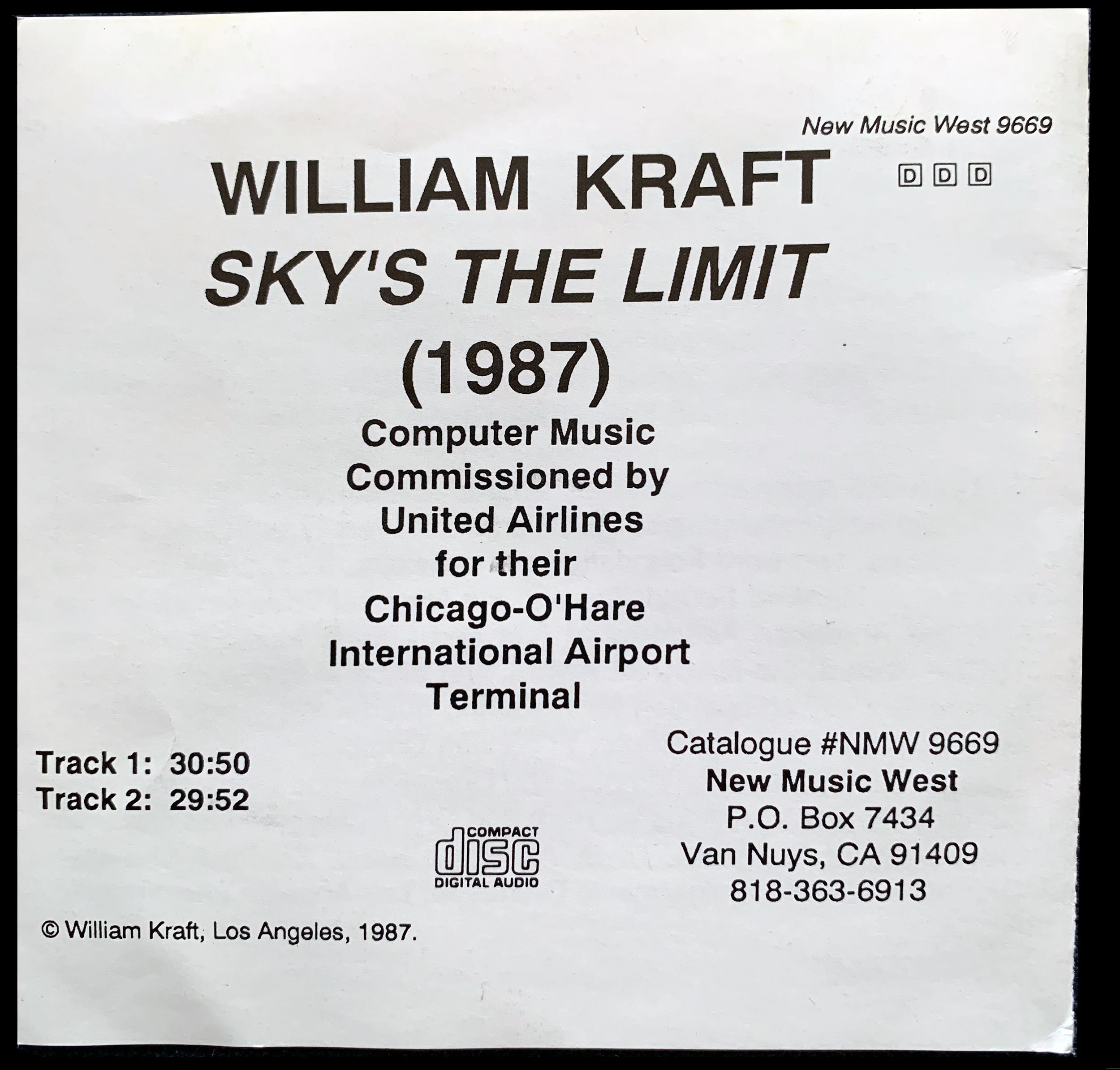
“Computer Music Commissioned by United Airlines for the Chicago-O’Hare International Airport Terminal”
It immediately brought to mind Brian Eno’s 1979 album “Ambient 1: Music For Airports,” a groundbreaking piece of music intended to soothe the nerves of airport travelers. The album is credited with giving birth to the ambient music genre. Was this CD a similar concept? I plunked down ten cents and hurried home to find out.
“Sky’s The Limit” is divided into two pieces, both roughly thirty minutes long. The first half is a gentle, somewhat downbeat composition of synthesizer swells, reaching towards an uncertain conclusion. It sounds similar to what would play in “Sim City” when your sim citizens’ morale is low. The second piece begins with a chorus of jaunty synthesizer horns that transform into a nearly atonal parade of robotic bells. It’s the kind of music that quickens your pulse while you listen to it. I absolutely loved it, but I couldn’t help but wonder: why on earth would this be played inside an airport? “Ambient 1” was intended to calm nerves. “Sky’s The Limit” felt like designed to do the opposite.
William Kraft (1923 - 2022) was a prolific American composer of modern orchestral music. His work ranges from film scores to large ensemble compositions. It didn’t seem like “Sky’s The Limit” was an especially notable addition in his oeuvre, and it was certainly an outlier in that it was composed electronically. Furthermore, it wasn’t available to stream on Spotify, Apple Music or even YouTube. It’s not even listed on Discogs! It seemed incredible to me that a physical release from a fairly well-known artist had no online record of its existence and no way to hear it other than the CD I held in my hands.
While I did find a few articles mentioning that Kraft had been commissioned to compose the piece, they mostly reiterated the info found in the CD’s liner notes: the music was intended to accompany the newly-unveiled sculpture by Michael Hayden that runs the length of the mile-long moving walkway that connects the new terminal at O’Hare with the old one. The sculpture is referred to as being “Lumetric” — which is not very helpful, because “Lumetric” is not a word. But I think it refers to “Lumens” and “Metrics” and is a fancy way of saying the light in the sculpture changes (which is does).
I went back to YouTube to watch a video of just how exactly the music works with the sculpture and found dozens videos of people riding the moving walkway. But something was off. The music playing was similar to Kraft’s composition, but it was definitely a different piece - it had a more traditional “electronic new age” vibe, with a swelling harp in sync with the sculpture’s pulsing lights. Where did William Kraft’s music go?
A bit more googling brought me to Bruce Duffie’s website, which featured an interview with Kraft from 1988, the year after “Sky’s The Limit” debuted. In the interview, they discussed how it fit into the walkway sculpture. The first part played on a loop as you entered, then it slowly faded into the second piece while you were in the middle of the walkway, then faded back to the first piece as you exited. So a traveller never heard the entire piece of music, just excerpts as they moved through the tunnel.
The interview also solved the mystery of why Kraft’s piece is no longer heard in the walkway: it was apparently removed about a month after it opened to the public because people found it confusing and stressful. Kraft attributes this to the fact that that it was played too quietly and therefore travelers didn’t get the full experience, in addition to the fact that sometimes art is ahead of its time.
From the interview:
Bruce Duffie (interviewer): Let me play devil’s advocate just for a moment. Is the tunnel, where travelers are trying to meet deadlines and all they are thinking about is getting to their planes, really the place for them to have an educational experience?
William Kraft: Well, it’s not educational by any stretch of the imagination. Nothing was meant to be educational. It was meant to be a pleasant and stimulating environment. I put it on that definition. The music I wrote was not something that had to be listened to; in fact, there is no beginning or end. It’s just environmental music.
According to Kraft, his music was replaced with a classical piece, possibly something by Gershwin.
William Kraft: …that’s such an insult to Gershwin! This is a test case for the problem we’re having with business. With the domination of business in the arts, a lot of our best talents just go right into commercial work because they want to survive! So here they are, doing jingles and all that sort of thing. Whether they’re artists or musicians, they find this lucrative; they can make money!
Kraft’s complaint, relevant in 1988, is truer than ever now. The notion of “selling out” as a pejorative has largely lost its place in American culture and we now have entire media ecosystems based solely on everyday people trying to get paid to promote products.
It’s unclear what, exactly, plays in the walkway these days. According to a 2021 article in SoundEffects, an interdisciplinary journal of sound and sound experience, it’s a combination of electronic music and bits and pieces of Gershwin’s “Rhapsody in Blue,” probably chosen because United Airlines uses that piece in many advertisements. Synergy finds a way.
In the end, it seems that Kraft’s music was played in the airport for about a month before being taken out of commission. Somewhere along the way a (presumably small) number of CD’s were printed and somehow, one ended up in in a thrift store in southern Vermont. Music that was, for a time, lost is now available to hear.
You can download mp3s and AIFFs of Sky’s The Limit here:
William Kraft died in 2022, and left behind a long and impressive career as a composer, performer, conductor, and teacher. I’ve shared “Sky’s The Limit” with a few friends who generally appreciate such oddities, and the consensus is that it is a curiosity, but not the great musical discovery that I seem to think it is. Perhaps the corporate suits at United Airlines were correct and this music is not meant for general consumption. But, when I listen to it, I feel like I’m communing with something that, unlike Gershwin’s “Rhapsody in Blue,” has a wealth of creative energy and excitement yet to be tapped.